


Meet the Curator: Behind the Scenes of the From Imagination to Reality Exhibit
For centuries, works of imaginative fiction have not only reflected the technological possibilities of their time, but also predicted and even directly influenced later innovations. The Science Library exhibit From Imagination to Reality brings this idea to life by pairing books with the realized innovations they foretold. The resulting exhibit takes viewers on a journey through time, highlighting the historical roots of “new” technology.
One of the exhibit’s curators, Rare Books and Special Collections Librarian Anastasia Armendariz, chose Edward Bellamy’s Looking Backward: 2000–1887. Published in 1888, Bellamy’s novel astonishingly predicts a number of the advances we take for granted today, including home electricity, credit/debt cards, and 24-hour music streaming. Here, Anastasia shares more about the book and her curatorial process while she was working on the exhibit.
“Looking Backward” in Langson Library
By Anastasia Armendariz
Edward Bellamy’s Looking Backward centers Julian West, a wealthy late-19th-century Bostonian who is discovered in a state of hypnotized sleep in an underground chamber by physician Dr. Leete in the year 2000. West awakens to a changed world, a socialist utopia in which Gilded Age wealth inequities and resulting unrest have been resolved in a cooperative society.
In addition to home electricity and credit/debit cards, Bellamy’s vision of the future includes ready access to consumer goods and a socialized economy that provides citizens with a high standard of living as well as autonomy in their vocations and leisure time.
Looking Backward is credited as the origin of utopian science fiction and was incredibly popular in its time. It was only outsold by Uncle Tom’s Cabin in its first few years of publication.
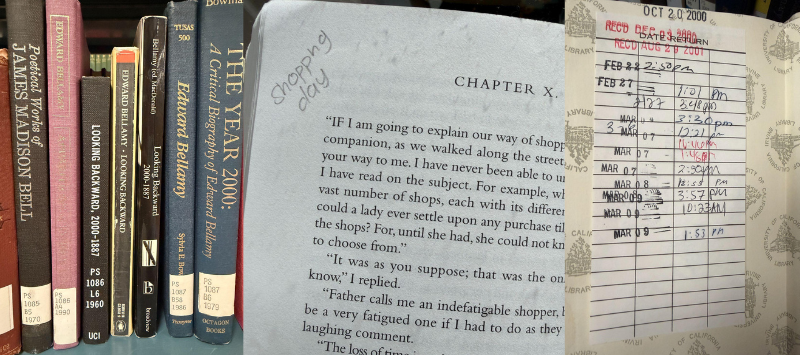
In checking for circulating copies of Bellamy’s book in the Langson Library stacks, I was inspired to “look backward” in a different way. Taking a closer look at the editions shelved in Langson Library revealed insights about when and how they’ve been used before.
For example, the copies in Langson bear signs of their use and engagement via annotations by past generations of Anteaters. In the 1982 Penguin Classics and 2003 Broadview editions, I found pencil marks by students from decades past.
These books also reveal changes in library checkout technologies: Pasted into the end matter of the books are due date slips with writing and stamps indicating when they were checked out in the early 2000s.
The 1960 and 2003 copies of the book were produced right around the time of the advent of some of the technologies mentioned in Bellamy’s utopian science fiction novel. For example, one copy was published in 1960, only two years after the launch of American Express’ first charge card in 1958. Although some predecessors of today’s big-box stores opened as early as the 1930s, Walmart opened its first store in 1962.
Printed at intervals long after the first edition, Langson’s copies illustrate changes in technologies and user behaviors over the last 60 years. What might enduring traces of today’s technologies say about us 60 years from now?
Three other books are also featured in the From Imagination to Reality exhibit:
- 2001: A Space Odyssey (1968), by Arthur C. Clarke, curated by Exhibits Coordinator Stephen Anderson
- Brave New World (1932), by Aldous Huxley, curated by Head of Reference and the Grunigen Medical Library Cynthia Johnson
- Ender’s Game (1977), by Orson Scott Card, curated by Library Assistant 4 Devorah Bader
The exhibit will be on display on the second floor of the Science Library through August 2026 during regular library hours. Visit the exhibits.lib.uci.edu for more details.